The big concepts
LOR is a 2D top-down, grid-cell, open-world building game in the family of Minecraft and Roblox — with one radical difference: new items, materials, machines, and creatures are created inside the game, through an in-world recipe and formula system, not through external mods or code. The world is designed to evolve beyond what its first creator can imagine.
Everything unfolds from ten commitments. Each card drills down to its full section.
Vision & positioning
LOR is an open world where players interact and create, like Minecraft or Roblox. It differs in where creation lives. In Minecraft, new item types require mods — creation happens outside the game. In Roblox, new gameplay requires coding against an API and submitting to a store — creation happens outside the game. In LOR, new formulas, items, machines, materials, and eventually life are created within the game, by the game's own rules.
This is not the default mode of play. Most players will build, farm, fight, and trade without ever authoring a recipe — just as most Minecraft players never write a mod. But the layer is always present, discoverable, and made of the same stuff as everything else.
The founding wish: ship enough basic content plus enough genuine novelty to make players think outside the box — all built with the same recipe system players will later use — so the world evolves into something the first creator could not have imagined.
Every aspect of the game is built the same way. Nothing is coded outside the basic engine: physics, the field simulation, the recipe system, and the changing-line law. Trees, towers, dragons, and the players themselves obey one rule set.
The three-tier authorship model
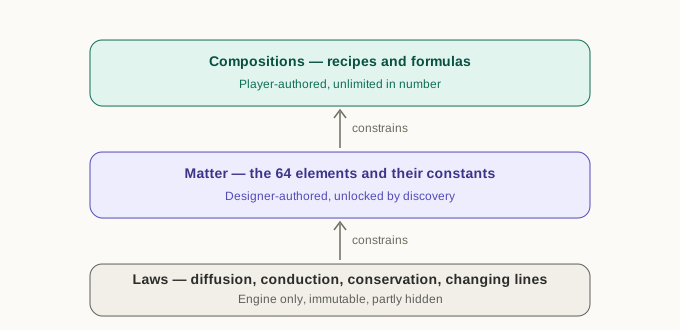
The central architectural line of the whole design: players never author physics; they author compositions. Physics lives in the matter, and recipes can only arrange matter — exactly as chemists invent millions of molecules without ever violating thermodynamics, because chemistry's authoring language has no verb for breaking physics.
| Tier | Contents | Author | Mutability |
|---|---|---|---|
| Laws | Field diffusion, conduction, conservation, changing lines, the grid, recipe matching | Engine only | Immutable; partly hidden at launch |
| Matter | The 64 hexagram elements and their constants | Designer, via the trigram→constants mapping | Fixed at launch; unlocked by discovery |
| Compositions | Recipes, formulas, complex items, blueprints | Players (and designer, for starting content, same system) | Unlimited |
Hidden physics is hidden the way deep-sea vents were hidden from 18th-century science: the laws were always running, but the matter expressing them hadn't been touched yet. A locked element is a field type the world already simulates but nothing yet emits. Discovery turns on matter; it never patches laws. Roughly 20% of the 64 elements are available at launch.
One substance, two topologies
Ground is matter without a boundary. An item is matter with one. Same substance, different topology.
The anatomy of a cell
Each grid cell has a floor slot (bulk element matter — the terrain: soil is an Earth-heavy hexagram lying down, a lava field is Mountain-over-Fire as ground), an occupant slot (at most one item — in the open world; container interiors are exempt), and field values across the four axes.
Because ground is ordinary matter: terrain is default infrastructure (the land conducts and blocks fields before any wire is laid — choosing where to build is the first engineering decision); ground transmutes (changing lines apply to the floor: scorched wet soil ages toward glass or ash, a frozen lake becomes Mountain-sealed walkable solid); and recipe ground-conditions generalise ("plant on Soil" is just a constraint on the floor slot's hexagram or its properties).
Boundaries and smelting
An item is a bounded parcel of element mass, its capabilities derived from that composition (§9). Smelting, grinding, and dissolving are one operation seen from different directions: removing or imposing a boundary. A furnace strips a boundary and returns matter to bulk; a recipe cuts a boundary around bulk matter.
Containment: nested boundaries
A container is a boundary with an inside — and boundaries have a hexagram, therefore a Boundary-axis polarity.
- No spatial limits inside containers. Geography exists for ground and uncontained items; interiors are non-spatial. No hardcoded slot counts — a deliberate alternate-reality choice, not just convenience.
- Contents keep participating in physics, contributing to the cell's field signature through the container's interface, attenuated by how Mountain-sealed or Lake-open that interface is.
- An apple tree — a living container with a very open boundary — holding five hundred apples is a beacon: the summed organic mass leaks scent and vitality for a huge radius, drawing creatures, dragons, and other players' senses. Infinite capacity is never free; open-container hoarding advertises itself.
- The player inventory (working name: the Infinity Pack) obeys the same rules — carry a tonne of ripe fruit and you are, to every nose in the region, a walking orchard. Field-sealed containers (the Stasis Vessel, §11) become precious craftables with zero special code.
- Open fork: whether inventory contents are exposed to external fields (ice melting as you cross a fire district). v1 lean: stasis, with the architecture permitting exposure later.
The four axes & eight trigrams
Founding rule: no integer power values, ever. Every property is a position on a paired-opposite spectrum. Nothing is better than anything else — only different. Players can never create an ultimate god-item, because every move along an axis is a move away from the opposite pole.
The I Ching's eight trigrams already come in four opposing pairs (the primal / Fuxi arrangement). The pairs are the axes:
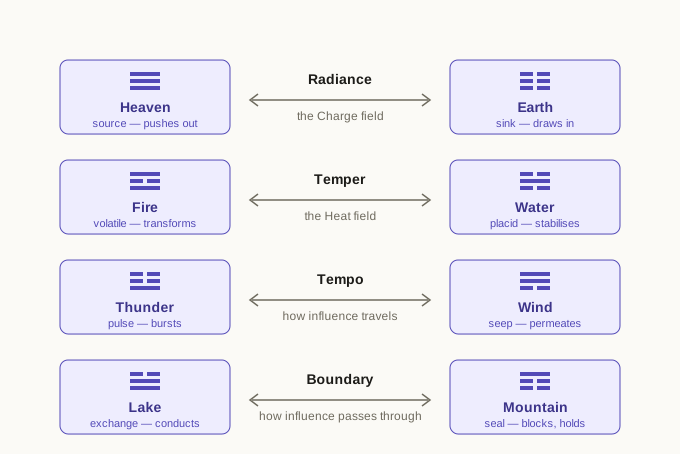
The axes split deliberately into two kinds: Radiance and Temper are content axes (what an element pushes into the world); Tempo and Boundary are dynamics axes (how influence moves — in bursts or gradients, through things or around them). Every trigram gets a distinct mechanical personality.
The specific names and assignments are current-best, not sacred. The structural commitment — four axes, each owned by a trigram pair, poles as trade-offs — is a decided design pillar: “four axes is the whole universe.”
Fields
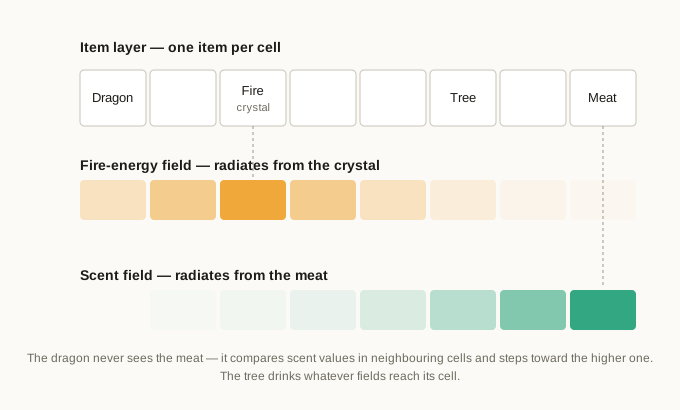
A field is a value at every cell, on its own layer, independent of the one-item-per-cell grid. Items don't contain fields; they disturb them: they emit (a fire crystal raises Heat), conduct (a wire passes it at low loss), seal (a Mountain-faced element blocks it), or absorb (a port drinks from it). Each tick, values spread to neighbours and decay, producing gradients.
Fields are signed
Each axis is one field, with two poles written to the same number. Fire pushes Heat positive; Water pushes the same Heat field negative. Consequences: opposition is physical (opposing emitters cancel; “nothing is better, only different” becomes a conservation law the simulation can't help but obey); the commons becomes a tug-of-war on shared numbers (warm a district, and another guild can actively cool it back — contested zones develop shifting frontiers where the field crosses zero; the physics is the politics); and cost and legibility halve (four scalar layers; one overlay per axis shows both poles).
One mechanism, three jobs
- The supply network. Ports bind to fields, not adjacent items:
in Power: field Charge ≥ 3. A thing just needs to stand somewhere its fields are strong enough. Wires and pipes still exist — as high-conductivity items that shape gradients — but adjacency chains are never mandatory. This dissolves the 2D “pipes must consume cells” limitation. - The senses of creatures. Long-range perception is gradient-climbing. Meat leaks Scent; a dragon's movement rule is one line: step toward the neighbouring cell with the highest Scent. The gradient encodes the distant world (ant-pheromone logic — cheap and lifelike).
- Collaborative terraforming. Fields are shared and additive — the medium through which players affect each other. Concentrating emitters genuinely changes a region; some recipes are only satisfiable in player-brewed biomes.
Derived fields (Scent as a reading of organic Radiance, Menace of hostile emitters) are allowed, deliberately — protect the purity of “four axes is the whole universe” where possible. Visibility is content: overlays at minimum, ideally in-game lenses and dowsing rods, so even seeing is crafted under the same rules.
Elements: body and interface
An element is a hexagram: six yin/yang lines, read as two trigrams. The lower trigram is the body — inner nature: Temper position, cohesion, storage. The upper trigram is the interface — outer expression: what it radiates or drinks, conducts or seals. This maps directly onto the I Ching's own inner-nature / outer-expression reading, and makes all 64 elements readable: learn eight trigrams, predict sixty-four elements.
Order matters: Fire-over-Mountain (a sealed exterior around a volatile core — an insulator that hoards heat and cracks open violently) is a different substance from Mountain-over-Fire (a hot radiating face on inert stone — lava rock, a natural heater).
Identity vs. display: an element's identity is its six lines; King Wen numbers are display only — tools store lines. The yin/yang line is the true primitive (possibly never exposed in-game); trigrams are the meaningful middle layer; hexagrams are the periodic table. New elements assembled from never-before-seen line combinations arrive with constants already determined by the trigram→constants mapping — not by the player's wishes, and not even by the designer on that day.
Changing lines: transmutation & discovery
In I Ching casting, lines come up young (stable) or old (changing — about to flip to their opposite). The I Ching is literally the Book of Changes. In LOR this is physics: the 64 hexagrams are the nouns; changing lines are the verbs. Every hexagram sits one flip from six neighbours; the elements form a connected graph, and transmutation along its edges is the chemistry engine.
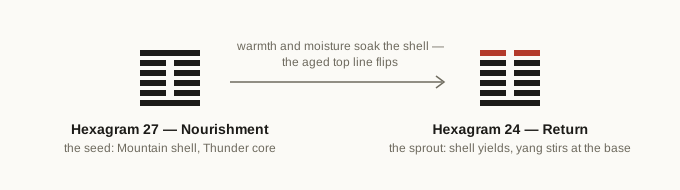
Aging: an instance's lines age under sustained field pressure; old lines turn to their opposite, and the matter is now a different element. Exposure depth: external fields reach the interface (upper trigram) lines first; only prolonged exposure reaches the body. Working rule within a trigram: outermost line first — giving every hexagram an erosion sequence (flagged: decided by the germination example, not first principles).
What changing lines buy:
- The discovery mechanism. Players induce new elements by holding known matter under the right conditions until the right lines turn. The hexagram graph is the tech tree — not a menu but territory, latent in the physics from day one.
- The “third thing” at frontiers. Steep gradients age lines fastest, so the contested zero-crossing between districts is a kiln. Obsidian forms where the tug-of-war is fiercest; the most politically contested land is the most alchemically fertile. Players fight over frontiers because frontiers make new things.
- Dumb-luck crafting. Recipes performed under field stress have a small chance (echoing the three-coin odds, ~1-in-8 per line) of a line turning during creation — a mutation. Attentive players notice mutations correlate with where they crafted, theorise, and do it on purpose.
Scope discipline: the tradition's 384 line-texts are a content mine for later. v1 needs only the mechanism: lines age, old lines turn, hexagram becomes hexagram.
Recipes, formulas & schematics
A recipe is how a thing is born. A formula is how it lives. Both attach to the same definition; they fire at different times — creation-time vs. tick-time.
ItemDefinition = { identity, element composition,
                   Recipe  (birth pattern)  — optional,
                   Formula (life behaviour) — optional }

Simple Item  = Recipe, no Formula
Complex Item = Recipe and Formula
Recipes (birth)
A recipe is a spatial pattern — items laid out on the ground (the world's floor as crafting table; the pattern is momentary, consumed at the flash of creation, the result occupies one cell). Recipes may also require ground conditions (floor-slot hexagram or properties) and field conditions (“these five items in a cross, where Heat ≥ 7”) — tying crafting to terraforming: some things can only be made in player-brewed biomes.
The pattern is checked whether or not you own the blueprint. Discovery is real: the world contains all its secrets physically. A schematic/blueprint is compressed knowledge — an inventory item projecting a recipe's layout onto the ground; tradeable, teachable, an economy for free. Certain recipes produce the ability to create new recipes: the bootstrapping layer, gated by knowledge plus materials.
Formulas (life): ports and stocks
A complex item declares ports (named input/output channels), stocks (internal levels), and rules. The formula says what it needs and produces — never how delivery physically arrives. Delivery is the field layer's concern and can grow without any formula changing.
DEFINE Tree
  BIRTH: Seed on Soil
  PORTS
    in  Moisture  field ≥ 2
    out Fruit     rate 1 / 30 ticks   # into its own held contents
  STOCK  Health max 3
  RULE
    if Moisture.satisfied: Fruit.produce; Health = max
    else: Health -= 1
    if Health == 0: become DeadTree

DEFINE Dragon
  SENSES  Scent                        # grants gradient-climbing
  MOVEMENT: climb Scent when hungry, climb Menace when fed
  PORTS
    in  Meat  item                     # discrete things move as items
    out Flame trigger enemy-adjacent
STOCK Energy max 10; drains 1 / tick- Items vs. fields at ports: discrete things transfer as items; continuous influences bind as fields. Player intuition: stuff versus influence.
- Movement is just a clause — a dragon and a tank are the same kind of thing; a tower simply lacks the clause.
- Starvation semantics: a tower at zero power idles; a tree at zero health becomes something else. Both ordinary rules. Input bars (level, type, what happens at zero) are a core UI surface.
- Designer-only syntax: free declarations like
EMITS Heat strength 9exist only at the Matter tier. The player-facing creator has no such clause — see the budget rule.
Everything once called a “factory” is a Complex Item: trees, towers, portals, dragons, spawn points, actual factories — and the players themselves, who may still be special, but feel most special existing by the same rule set.
The budget rule
Capabilities are inherited from ingredients, never declared. A player-made item's ports, emissions, and conductivities derive from the element mass placed into its recipe. Put 3 units of fire-element in → it can emit Heat up to a budget of 3. Include none → there is no way to make it emit Heat, any more than you can build a magnet out of wood. The player's creative input is what it's made of, in what arrangement, and how its inherited capacities are allocated — a fierce short-range emitter, a gentle wide aura, emission traded for durability. Trade-off dials within a conserved budget: the no-god-items principle with a mechanism behind it, and the enforcement of the tier model — the authoring language simply has no verb for breaking physics.
The derivation function is the hardest design object in the game. Too simple → recipes converge on obvious optima and creation feels like a spreadsheet. Too opaque → no theories form and experimentation is a slot machine. Target: theorisable — attentive players predict a new combination correctly ~80% of the time; the remaining 20% is where wonder lives.
World & social structure
- Home space: each player starts in a procedurally generated safe space — only they can change it; only invitees enter.
- Surrounds: a ring where chosen others may also build.
- Commons: open areas where anyone contributes. With signed fields, this is where collaboration and contest become physical: shared gradients, brewed biomes, frontier kilns.
- Battle arenas: opt-in competition; entrants stake items, winner takes the spoils. (Open: whether commons towers/spawners can harm players directly — lean: they harm only created things, not players, outside arenas.)
- Tower defense is a chosen mode within the same systems: towers and spawn points are ordinary Complex Items.
- Players are Complex Items — ports (food in), stocks, senses, movement — under the same physics as everything they create. Creating new life is an intended late frontier: with enough of an element, a player should be able to create life of that kind — which is just a Complex Item with a formula.
New players see only a fraction of what exists; what they see, learn, and can do grows with their own wish to explore and experiment.
The first derived elements
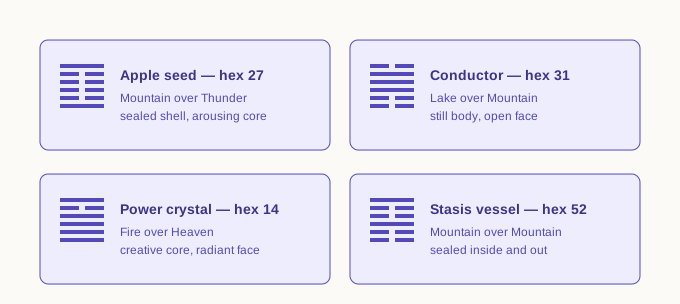
Four objects hand-derived to stress-test the framework. In each case the King Wen tradition's own name for the resulting hexagram agreed with the derivation:
| Thing | Structure | Hex | Traditional name | Reading |
|---|---|---|---|---|
| Apple seed | Mountain over Thunder | 27 | Nourishment | Sealed shell around a latent shock of growth |
| Conductor | Lake over Mountain | 31 | Influence | Inert still body, a face that trades everything — a stone that carries |
| Power crystal (Heat) | Fire over Heaven | 14 | Possession in Great Measure | Creative reservoir with a volatile radiant face — “fire in heaven above” |
| Stasis vessel | Mountain over Mountain | 52 | Keeping Still | Sealed both ways: contents neither age nor leak; joins no automation |
Germination is a changing-line event: plant the hex-27 seed in Earth-heavy ground; moisture and warmth soak the interface; the Mountain face's top line ages and turns; Mountain-over-Thunder becomes Earth-over-Thunder — hexagram 24, Return, “yang stirs at the base” — and the Return-matter is the sprout, whose formula runs the tree. Seed → Return → Tree: the first complete lifecycle, every step a line-flip or a formula tick.
The Charge crystal is hex 14's neighbour: Heaven-over-Fire — hexagram 13, Fellowship — radiates Charge instead of Heat. Two power sources, two fields, one structural move, neither hardcoded — resolving the early “generic electricity vs. elemental crystals” question: both, as neighbours in the table.
Design principles
- KISS for v1. As complex as needed, no more. Always state the simplicity trade-off.
- Nothing better, only different. Spectrums, never integer power — enforced by signed fields and conserved budgets, not moderation.
- Everything by the same rules. One rule set for trees, towers, dragons, players. Specialness comes from composition, not exceptions.
- Discovery is real. Secrets exist physically before anyone knows them. Blueprints are knowledge, not permission.
- Theorisable wonder (80/20). Predictable enough for science, surprising enough for magic.
- The world evolves past its creator. Ship primitives and novelty; let players take it somewhere unimaginable.
- The structure is the commitment; the poetry is negotiable. Where LOR's physics diverges from a traditional reading, physics wins. (In practice the tradition keeps agreeing.)
Open questions & flags
Decided-by-example (adopted, flagged for review)
- Line exposure order — “outermost interface line ages first” was chosen because it makes germination yield Return; it implies an erosion sequence for all 64 elements.
Open forks
- Inventory contents exposed to external fields? (v1 lean: stasis; architecture permits exposure later.)
- The exact trigram→constants mapping — the derivation function; hardest design object. Current axis names are current-best placeholders.
- Which derived fields exist (Scent, Menace, Moisture: derived vs. canonical)? Protect “four axes is the whole universe.”
- Commons combat: can towers/spawners hurt players outside arenas? (Lean: no.)
- The 384 line-texts — deferred entirely; mechanism only at v1.
- Field simulation engineering: naive per-cell diffusion won't scale; chunking, update-on-change, or coarser field resolution are the known approaches. First real engineering constraint.
- Tooling: an element-authoring tool (“search by concept → candidate hexagrams”; store six lines as identity, King Wen number as display) is the first build target and doubles as element documentation. No existing I Ching MCP connector was found; it will be first-party.
Benched (not dead)
- Full plant lifecycles with bounded input schedules (v1: a tree may appear immediately on planting).
- The early four-attribute table (Thermal/Cohesion/Vitality/Charge) — superseded by the trigram axes; its spectrum instinct was adopted wholesale.
Glossary
| Term | Meaning |
|---|---|
| Axis | One of four paired-opposite spectrums (Radiance, Temper, Tempo, Boundary), each owned by a trigram pair |
| Blueprint / Schematic | Inventory item projecting a recipe's layout; optional knowledge, never permission |
| Body | An element's lower trigram: inner nature, storage, cohesion |
| Boundary | What separates an item from bulk matter; containers are boundaries with insides; every boundary has a hexagram |
| Changing line | A line aged by sustained field pressure; when it turns, the matter transmutes |
| Complex Item | A bounded parcel of matter carrying a Formula (tree, tower, dragon, player, factory) |
| Element | One of 64 hexagrams; the periodic table of LOR |
| Field | A signed per-cell value layer that radiates, conducts, and cancels; one per axis |
| Formula | Tick-time behaviour of a Complex Item: ports, stocks, rules, movement, senses |
| Ground | Bulk (boundless) element matter in a cell's floor slot; terrain |
| Infinity Pack | The player inventory: non-spatial inside, physically participating outside |
| Interface | An element's upper trigram: field behaviour — emit, conduct, seal |
| Port | A named input/output channel on a Complex Item, bound to a field or to items |
| Recipe | A creation-time spatial pattern (plus optional ground and field conditions) that produces a defined thing |
| Simple Item | A bounded parcel of matter with no Formula |
| Stasis vessel | Hexagram 52 container: field-sealed both ways |
| Stock | An internal level on a Complex Item (health, energy) |
| Trigram | Three lines; eight exist, in four opposing pairs; the poles of the axes |